
SUM Unveils 'Abyss,' a Data Operating Platform Powering the Physical AI Data Flywheel
[Image by SUM(에스유엠)]
As artificial intelligence moves beyond generative AI toward Physical AI—AI systems capable of perceiving, understanding, and acting in the physical world—the ability to efficiently collect, process, and continuously learn from real-world data has become a key competitive differentiator.
Autonomous driving represents one of the most demanding applications of Physical AI. Rather than relying solely on increasingly sophisticated algorithms, the performance of end-to-end (E2E) autonomous driving models depends on how efficiently real-world data can be converted into training data and fed back into deployed vehicles. Ultimately, the competitiveness of Physical AI is determined not only by the model itself, but by the speed and quality of its data flywheel.
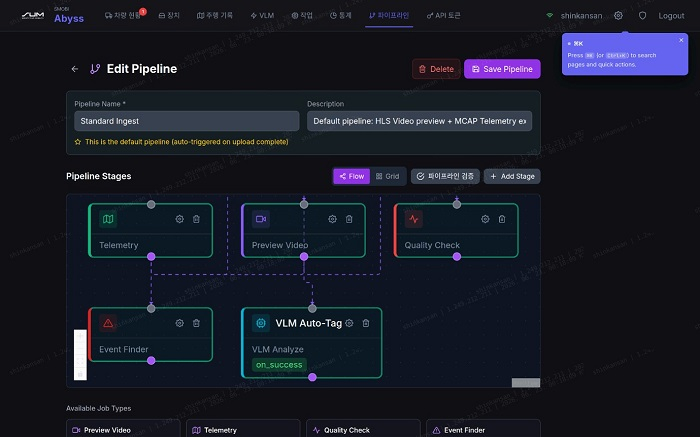
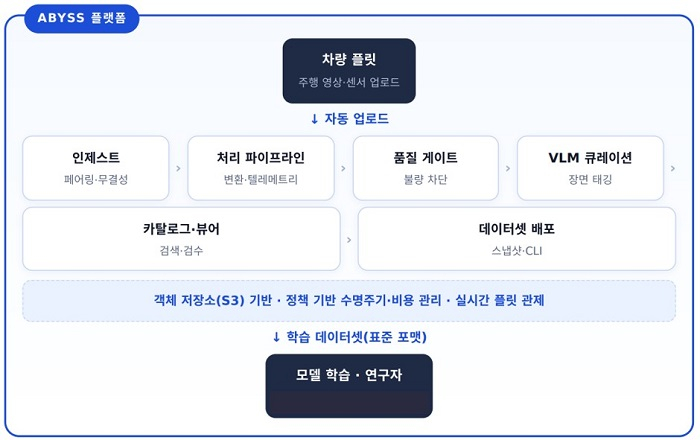
SUM's Abyss was developed specifically to address this challenge. The platform automatically ingests multi-camera video streams and vehicle sensor data, then performs data integrity verification, temporal synchronization, quality assessment, automated labeling, dataset generation, and distribution through a unified pipeline. By automating the entire workflow, Abyss transforms raw driving data into AI-ready datasets while streamlining the data lifecycle from collection through model training.
[Image by SUM(에스유엠)]
To support enterprise-scale deployment, collected video data is automatically anonymized by removing personally identifiable information such as pedestrian faces and vehicle license plates before storage and distribution. This enables organizations to maximize data utilization while maintaining regulatory compliance and protecting privacy.
Abyss also leverages VLMs to analyze driving scenarios and evaluate dataset composition across road types, weather conditions, time of day, and operational scenarios. By identifying underrepresented situations, the platform helps determine which real-world data should be collected next, continuously accelerating the Physical AI data flywheel.
"In the Physical AI era, sustainable AI growth depends less on individual models and more on the operating system behind the data," said a SUM spokesperson. "Abyss connects real-world data to AI and continuously feeds improved intelligence back into real-world operations. Our goal is to build the data infrastructure that enables Physical AI to evolve through continuous learning."
The spokesperson added that while Abyss was initially developed for autonomous driving, the platform is expected to serve as core infrastructure for a broad range of Physical AI applications, including smart logistics, smart ports, smart factories, and robotics.
Abyss has been designed to align with Korea's recently introduced autonomous driving data standards covering the entire data lifecycle. Going forward, SUM plans to further enhance the platform using operational autonomous driving data while expanding collaborations across industries to help accelerate the broader Physical AI ecosystem.
정현식 기자