최신기사
FLEXELL SPACE Selected as Lead Organization for Large-Scale National R&D Project on Space Perovskite Tandem Solar Cells
Uiwang-si, Gyeonggi-do, South Korea, July 2nd, 2026 – FLEXELL SPACE, a South Korean company specializing in space solar cells, announced that it has been selected as the lead organization for a new national R&D project titled “Development and Verification of Low-Cost, High-Efficiency Tandem Modules for Space Applications.” The project is part of the Energy Technology Development Program promoted by the Korea Institute of Energy Technology Evaluation and Planning (KETEP) under the Ministry of Climate. The project, with a total budget of KRW 10.7 billion(USD 7 million), will be carried out over the next three years. Its objective is to develop low-cost, high-efficiency, and highly reliable space solar cell modules, which are expected to become core infrastructure in the New Space era, and to verify their applicability in actual space environments. To concentrate national capabilities in this strategic field, Flexell will serve as the overall lead organization, forming a large-scale consortium with leading Korean research institutes and universities, including the Korea Institute of Energy Research (KIER), the Korea Electronics Technology Institute (KETI), and Gyeongsang National University. Space solar cells are a critical power source for satellites, space stations, space-based solar power systems, and space data centers. However, existing space solar cells face limitations in meeting the rapidly growing demand of the New Space market due to the high cost of materials, limited production capacity, and high unit prices. In particular, next-generation space industries such as low Earth orbit satellite constellations, space-based data processing facilities, and long-duration space platforms are expected to require large-scale power generation. As a result, the development of solar cell modules that are lighter, more cost-competitive, flexible, and capable of long-term durability has become an essential technological challenge. Based on its next-generation tandem solar cell technology using copper indium gallium selenide (CIGS) and perovskite materials, Flexell has been developing space power solutions that improve cost competitiveness compared to conventional gallium arsenide solar cells while overcoming the weight and long-term reliability limitations of silicon solar cells. Through this project, the company plans to carry out the design of high-efficiency tandem cells and modules optimized for space environments, the development of modules for low Earth orbit satellites, durability verification under extreme conditions such as radiation, thermal cycling, and vacuum environments, as well as manufacturing cost and economic feasibility analyses. The selection of this project is significant in that a private Korean space solar cell company will lead a national R&D project in the converging fields of energy and space. Flexell Space is expanding beyond cell-level space solar technologies into modules, arrays, and mission-specific power solutions tailored to customer requirements. Through this project, the company aims to further strengthen the commercialization foundation for Korea’s space solar cell technology. Flexell Space is already expanding technical collaboration with domestic and international satellite manufacturers, space station developers, space data center companies, and other space companies for the application of next-generation space solar cells and modules. The company’s strategy is to secure both price competitiveness and technical reliability in the global space power market through space environment testing, in-orbit demonstration, customized module design, and advancement of mass-production processes. “This project selection is an important milestone demonstrating that FLEXELL SPACE’s high-reliability space tandem solar cell technology is closely aligned with Korea’s national strategy for next-generation energy and space industries,” said Timothy Ahn, CEO of Flexell Space. “Space solar cells are not products that can be evaluated solely by high efficiency. They must operate reliably for long periods in actual space environments, be flexibly designed according to customer mission requirements, and offer the economic feasibility required for the era of large-scale space infrastructure.” Ahn added, “Through this project, Flexell Space will accelerate the localization and commercialization of low-cost, high-efficiency, and highly reliable tandem modules for space applications. We will continue to grow into a key space power technology company serving not only satellites, but also space stations, space data centers, lunar missions, and deep-space exploration.” In addition, Flexell Space plans to use this project as an opportunity to strengthen industry-academia-research collaboration with KIER, KETI, and Gyeongsang National University, while contributing to the development of Korea’s domestic space solar cell ecosystem. Through these efforts, the company aims to enhance the localization potential of space power components that have traditionally relied heavily on overseas suppliers and secure differentiated space solar cell technologies for the global market. 정현식 기자space organization space solar space applications solar cells
2026.07.01. 18:00
Klook Partners with Korea Tourism Organization to Expand Transportation Access for Foreign Travelers
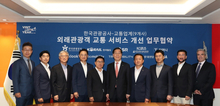
Seoul – Klook, a global travel and leisure e-commerce platform, has signed a business agreement with the Korea Tourism Organization to make travel more convenient for foreign travelers. On May 31, the Korea Tourism Organization and eight major transportation organizations and business entities in Korea, including Klook, signed a business agreement to "Expand Transportation Access for Foreign Travelers." Klook is the only global OTA among participating companies. With the agreement, Klook will cooperate with the National Express Bus Transportation Business Association and T-Money to establish an intercity express bus reservation and payment system in its application to assist international travelers. Express bus, an important means of transportation for traveling in Korea, is expected to make access to transportation services for foreign tourists easier through its collaboration with Klook. Klook will act as a bridge connecting tourists and Korea’s public transportation system. It plans to utilize its global presence to actively promote express buses while helping foreign tourists easily make reservations with its tech solutions. Supporting 15 languages, 41 payment currencies, and 40 simple payment services, Klook has more than 40 million monthly visitors worldwide. Using the Klook platform, users can conveniently make reservations and payments for travel products anywhere in the world. The utilization of Klook by foreign tourists to explore Korea is seeing a notable increase. In the first quarter, Klook's inbound (foreigners' travel to Korea) sales increased by 63 percent compared to the same period of 2019, exceeding the pre-COVID-19 days. "By having intercity express bus reservations made on Klook, accessibility for foreign tourists will be significantly improved," Klook Korea General Manager James Lee said. "Klook will continue to strive to attract tourists and make traveling in Korea joyful by utilizing its strong technological foundations and global presence." The Korea Tourism Organization will provide an integrated regional travel-transportation service, "Easy Book, Easy Go," on its Korea Tourism website supported in English, Japanese, and Chinese. It introduces major transportation means in Korea to foreign tourists, including transportation recommendations and reservation links to destinations by region and theme. The organization plans to actively implement promotions and marketing campaigns to advocate domestic transportation in collaboration with the relevant industries. Meanwhile, on May 23, the eight participating companies held the “Proclamation of Innovation for Foreign Tourist Transportation Service” at the "Visit Korea Year 2023-2024 Cooperation Launching Ceremony.” Attendees include First Lady Kim Kun-hee, Minister of Culture, Sports and Tourism Park Bo-gyun, Chairman Lee Bu-jin of the Visit Korea Year Committee, Visit Korea Year Ambassador Cha Eun-woo, and approximately 80 tourism companies and associations attended the event hosted by the Ministry of Culture, Sports and Tourism, the Visit Korea Year Committee, and the Korea Tourism Organization, to wish success of the "Visit Korea Year 2023-2024." From left: Lotte Rental CEO Choi Jin-hwan, T-map Mobility CEO Lee Jong-ho, T-Money CEO Kim Tae-keuk, SR CEO Lee Jong-guk, National Express Bus Transportation Business Association Chairman Lee Gwang-jae, Korea Tourism Organization President & CEO Kim Jang-sil, KORAIL acting CEO Ko Jun-yeong, Kakao Mobility CEO Ryu Geung-sun, Klook Korea General Manager James Lee, Visa Korea CEO Patrick Storey 이동희 기자 ([email protected])transportation organization korea tourism transportation access transportation services
2023.06.14. 21:11